
Mito Red Light Therapy Review: How to Save Money

How to Choose the Best Mito Red Light Panel

Sorting through the Mito Red Light panel choices can feel overwhelming, but you’re in the right place to find clarity.
Mito offers three distinct families of red light therapy panels: Mito Pro+, Mito Pro X, and Mitoadapt.
Is the most expensive option automatically the best? Not at all.
We’ve sifted through every feature to guide your wellness investment. This guide reveals how to spend less money while achieving faster, more deeply penetrating therapy sessions for your self-care journey.

What Are the Three Mito Red Light Families?

Mito Red Light simplifies its offerings into three main lines of panels: Mitoadapt, Mito Pro+, and Mito Pro X.
Each of these families comes in a range of sizes, from convenient tabletop units to immersive full-body panels.
The key is to first choose the model family based on the features that align with your wellness goals. You’ll learn all about those features in this article.
Once you’ve selected a family, you can then choose the right size for your space and needs and begin your journey to better health.
Why Does Panel Size Matter for Your Wellness Routine?

The size of your panel directly corresponds to how much of your body you can treat in a single session.
For instance, a tabletop panel is perfect for focusing on your head and neck, which is ideal if you’re using red light therapy for your face.
However, to treat your entire body, you would need multiple sessions: one for your torso, another for your legs, and then repeat the process for your back.
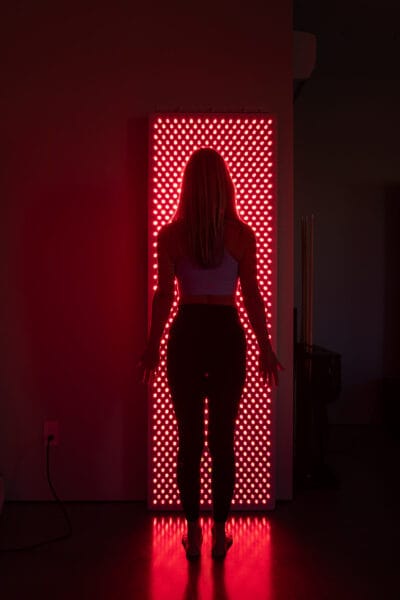
A larger, full-body panel allows you to treat your entire front or back in one efficient session, simplifying your routine and saving you valuable time.

What Are the Features of the Mitoadapt Series?

The Mitoadapt family includes four distinct sizes to fit various needs and spaces: Min, Mid, Max, and Mega.
The coverage for each size, based on an average person of five feet six inches, is as follows:
- The Min is 12 inches tall, covering about one-fifth of the body.
- The Mid is 24 inches tall, covering about one-third of the body.
- The Max is 36 inches tall, covering about half of the body.
- The Mega is 65 inches tall, offering full-body coverage and more.
Remember, the features within the Mitoadapt family are consistent across all sizes. The primary difference is the treatment area you can cover in one session.
What About the Mito Pro+ and Mito Pro X Series?
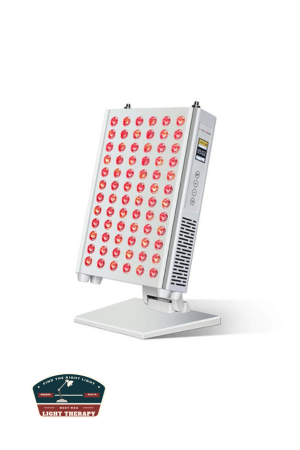
The Mito Pro+ and Mito Pro X families also offer four sizes, labeled 300, 750, 1500, and MEGA.
These panels are slightly larger than their Mitoadapt counterparts, providing a bit more coverage at each tier. For a person who is five feet six inches tall, the sizing is:
- The 300 is 13 inches tall (about 1/5 body coverage).
- The 750 is 23 inches tall (about 1/3 body coverage).
- The 1500 is 43 inches tall (about 1/2 body coverage).
- The MEGA is 66 inches tall (full body coverage and then some).
Just like the other lines, the smaller the device, the more sessions you’ll need to treat your entire body. A larger panel in either the Pro+ or Pro X line means greater efficiency for your self-care routine.
How Do Therapeutic Light Wavelengths Work?

Are you focused on wrinkle reduction, calming acne, or soothing muscle pain? The specific wavelengths of light emitted by a panel determine its primary benefits.
The great news is that red and near-infrared wavelengths are the powerhouses of light therapy. As confirmed by leading health institutions, a panel with just these wavelengths can be incredibly effective.
This holds true for goals like pain relief and anti-aging skin care. For acne, the addition of blue light is often recommended for best results.
However, none of the current Mito Red Light panels include blue light. If that is your primary concern, you might consider these other options for red light therapy for acne.
What Wavelengths Do All Mito Panels Include?

All three Mito panel families—Mitoadapt, Mito Pro+, and Mito Pro X—are equipped with four foundational wavelengths: 630nm, 660nm, 810nm, and 850nm.
This translates to two beneficial shades of red light and two powerful shades of near-infrared light. The theory is that multiple wavelengths within the same color spectrum may enhance light absorption by your cells, though research is ongoing.
The 630nm and 660nm red light are primarily used for skin health, addressing concerns like wrinkles, fine lines, dullness, and redness.
The deeper-penetrating 810nm and 850nm near-infrared light reach into muscles and joints. They are exceptional for pain relief, muscle recovery, and boosting cellular energy, helping your body heal from within.
The Mito Pro X Difference: The Power of 590nm Amber Light

While all models share the same core red and infrared wavelengths, the Mito Pro X line stands apart by adding a fifth wavelength: 590nm amber light.
This addition brings a unique set of skin, bone, and longevity benefits to your therapy sessions. Amber light has been scientifically observed to offer a wide range of positive effects.
Some of the many benefits associated with 590nm amber light include:
- Improving bone health and reducing edema (s)
- Reducing sun-induced redness and calming skin (s)
- Reducing unwanted pigmentation and rosacea lesions (s)
- Reducing wrinkle volume (s, s)
- Promoting hair growth (s)
- Increasing cellular energy and decreasing inflammation (s)
This exclusive feature makes the MitoPro X line a more comprehensive tool for your self-care toolkit.
Which Model Offers the Best Value?

When comparing the Mito Red Light prices, a clear pattern emerges that doesn’t favor the most expensive option.
The Mitoadapt is significantly more expensive than both the MitoPro+ and MitoPro X. Let’s look at the full-body “Mega” panels to see the difference.
- The Mitoadapt Mega is priced at $4999.
- The MitoPro Megax is priced at $2699.
- The MitoPro Mega+ is priced at $2499.
The Mitoadapt Mega costs almost $2300 more than the MitoPro Megax. Meanwhile, for only $200 more than the MitoPro+, the MitoPro X gives you the advanced 590nm amber light, making it a powerful upgrade for a minimal price increase. You can compare the models on Mito’s site to see for yourself.
Why Does the Number of LEDs Matter?

The number of LEDs in a panel is crucial because more lights deliver more healing energy to your body in less time.
This is where the MitoPro Megax truly shines, featuring an impressive 1200 LED chips to drench your body in therapeutic light.
In comparison, the Mitoadapt Mega has 720 LEDs, and the MitoPro+ Mega only has 600.
For just $200 more than the MitoPro+, the MitoPro X gives you the unique 590nm amber light plus an additional 600 LEDs—effectively doubling the light output for a truly powerful session.
- MitoPro Mega+: 600 lights
- MitoPro Megax: 1200 lights
- Mitoadapt Mega: 720 lights

The Clear Winner: Why the MitoPro X Offers Superior Value

After a detailed comparison, the MitoPro X series emerges as the undeniable best value for anyone serious about their wellness journey.
It masterfully combines the most advanced features with a far more accessible price point. You receive the unique benefits of the 590nm amber wavelength, which supports skin, energy, and cellular health.
Most impressively, it doubles the number of LED lights compared to the MitoPro+ for only a small price increase. When measured against the much costlier Mitoadapt, the MitoPro X offers more technology for less money.
For the best bang-for-your-buck and the most cost-effective path to whole-body wellness, the choice is clear.
Ready to Start Your Red Light Therapy Journey?

Investing in your health should be a clear and confident decision. The MitoPro X family, and specifically the MitoPro Megax, provides the most advanced technology and greatest therapeutic power for your money.
It provides five beneficial wavelengths and double the lights of its closest competitor, ensuring every session is potent and efficient.
By choosing the MitoPro X, you are not just buying a red light panel; you are investing in a powerful tool for natural healing and daily self-care.
Ready to feel your best? Click the button below to explore the best panel Mito Red Light has to offer.