
Red Light Therapy for Skin Health (11 Powerful Uses)

Table of Contents
Best Red Light Therapy for Acne
- The best red light therapy devices for acne use infrared, red, and blue light
- The LightpathLED Mini is the best portable acne device.
- The LightpathLED Diesel series is the only panel for acne I recommend.
- The NovaaLab Glow is the best face mask for acne.
- The Solawave Bye Acne is the most affordable acne device.
Best Red Light Therapy for Aging Skin
- The best red light therapy for aging uses red and infrared light.
- Use my aging red light therapy quiz to find the best device.
- The HigherDose is the best face mask for wrinkles and sagging.
- The MitoPro 300 is the best small panel (tabletop) for wrinkles and sagging.
Best Red Light Therapy for The Face
- Learn how to shop for a red light therapy face mask.
- The best red light therapy for the face treats the face, neck, and chest with red, infrared, and sometimes blue, yellow, or green light.
- While Celluma is an excellent red light therapy pad, it’s expensive. Hydraskincare is a good alternative that costs much less money.
- The DPL II is a wildly popular red light therapy face panel.
Best Red Light Therapy for Other Skin Conditions
- For eczema, rosacea, psoriasis, and dermatitis: Skin eruption, scaling, and inflammation symptoms respond to acne’s wavelengths. Scroll up for the acne choices.
- For age spots, bruising, cellulite, dryness, and scars: Pigmentation, edema, moisture, and scar symptoms respond to anti-aging wavelengths. Scroll up for the wrinkle and sagging skin choices.
How to Choose the Device for Your Skin
The best skin devices are face masks, panels, and handhelds.
The best, specifically for the face, are panels and face masks.
If you use a face mask, you might consider getting a neck attachment for sagging neck skin or sun-damaged chest skin. A tabletop panel is large enough to reach the face and neck simultaneously.
Face Masks
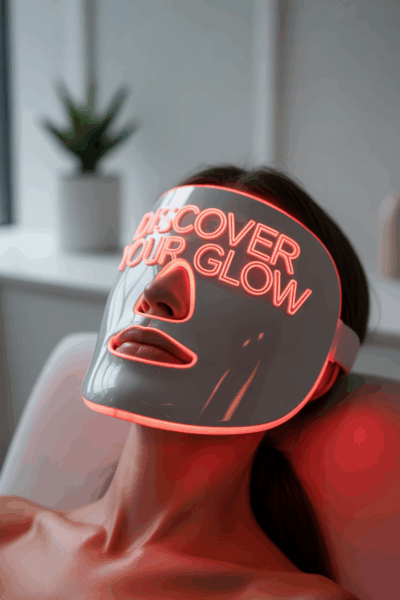
Face masks often come with neck attachments for sagging skin in the neck area. The advantage of a red light mask is targeted coverage. You know you’re aiming the light at the face (and neck) because the device sits right on the face.
A disadvantage is that wearing any device on the face is kind of awkward. Plastic doesn’t feel good and can pinch (get a silicone mask if you go this route). It’s also challenging to use a mask elsewhere on the body. Learn how to shop for a face mask, or check my review of my favorite mask for aging, pimples, and eczema/psoriasis (an all-in-one device).
Panels

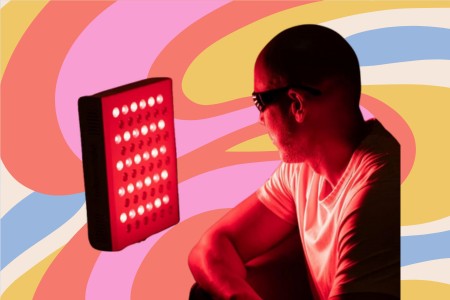
Tabletops and panels, on the other hand, are as easy to aim at the face as the foot, so they’re more versatile. You place the device 6-12 inches away for the fastest therapy sessions. The advantage of a tabletop or panel is that you can use it for muscle and pain relief as well as for skincare on the back or butt. The downside is that tabletops are bulky, and panels take up lots of space. See my reviews for the best tabletop for the aging face and for pimples, eczema, and psoriasis.
Handhelds
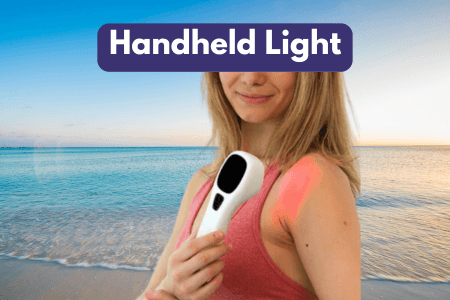
Handhelds take up almost no space and are the best for traveling, too. The advantage of a handheld is its portability and how targeted you can get by aiming it at problem areas. The disadvantage of handhelds is that you can’t use them “hands-free” the way you can with a face mask and tabletop/panel. If the device is small, you might need to do separate areas of the face at a time. See my reviews of the LightpathLED Mini, which works equally well on pimples and aging skin.
Which Wavelengths Are Best for Skin Health?

Infrared wavelengths reach deeper into the skin than red, and the combination covers several layers of skin cells. Both reduce inflammation, promote skin cell turnover, and help with every skin benefit listed in this article.
Yellow and green lights are soothing, reduce redness, and promote a healthy glow. Blue light reduces the symptoms of acne, eczema, and psoriasis.
Red Light
Red light is used for wrinkles, pigmentation, sagging, sun spots, scars, stretch marks, and cellulite.
Infrared Light
Infrared light penetrates deeper than red light and treats wrinkles, pigmentation, sagging, sun spots, scars, stretch marks, and cellulite.
Amber (Yellow) Light
Amber is between red and green, and the yellow band of light dominates. The yellow and amber wavelengths help calm inflammation and redness. They are useful for rosacea, eczema, psoriasis, acne, and pigmentation.
Green Light
Green light is soothing to the skin and brain. A wavelength of green light is FDA-approved to calm migraine headaches. Green softens the skin and reduces redness. It is useful for rosacea, eczema, psoriasis, acne, and pigmentation.
Blue Light
Blue light is energetic as it borders on the ultraviolet spectrum. Blue is not energetic enough to be dangerous but powerful enough to kill acne-related bacteria. Blue is useful for treating acne, eczema, psoriasis, rosacea, and other dermatitis.
What is Red Light Therapy for the Skin?
Hundreds of studies show how effective red light therapy is in reducing acne symptoms.

Red light therapy was discovered in 1967 and goes by many names, including:
- LED Light Therapy
- Photobiomodulation Therapy
- Low-Level Laser Therapy
- Low-Level Light Therapy
It’s much more than using red light for skin health. The “red” in “red light therapy” is a shortcut term for “all visible light and infrared (which is invisible).”
Red light therapy uses the visible spectrum (blue, green, yellow, orange, and red) and infrared light to stimulate mitochondria and healing processes. It’s only fair also to call it:
- blue light therapy
- green light therapy
- yellow or amber light therapy
- orange light therapy
- infrared light therapy
How Does Red Light Therapy Improve Skin?
- The science behind red light penetration and skin cell absorption
- Cellular mechanisms: How red light stimulates collagen and elastin production
- The role of mitochondria in red light therapy’s effectiveness
Skin cells are sophisticated machines that host thousands of energy factories called mitochondria. The mitochondria produce adenosine triphosphate (ATP), which I like to call “biological batteries.”
The mitochondria are the energy factories, and the ATP are the batteries they produce. The healthier your mitochondria, the more energy factories you have and the more batteries you make. Red light therapy supports mitochondria in making ATP. The result is more energy for repair and healthier functionality.
Imagine your skin cells as tiny, sophisticated machines. When exposed to red light, these cellular machines spring into action, much like solar panels converting sunlight into energy. This light energy boost can kick-start processes like collagen production and reduce inflammation, potentially leading to healthier skin.
How Do You Integrate Red Light Therapy Into Your Skin Care Regimen?
To integrate red light therapy into your skincare routine:
- Wash and pat dry your treatment area.
- Use your red light therapy device on your skin.
- Apply the rest of your products.
You can combine red light therapy with other options, such as retinol. Like chemical peels, retinol is not suitable for sensitive skin.
What Are the Side Effects of LED Light Therapy for the Skin?
Pigmentation is the only recorded side effect of using red light therapy on the skin. The evidence is mainly anecdotal as there is very little about the issue in the literature.
If the light is too bright, it can cause eye discomfort. Lasers can blind the eyes but LEDs are safe so long as you don’t stare at a very bright one.
Many red light therapy devices are entirely too bright, but keeping your eyes closed will give you eye benefits without side effects.
Here’s the rule: If you need to squint, keep your eyes closed.
Blue light is potentially dangerous to the eyes and should be used appropriately (don’t stare at it and consider wearing goggles). Blue light suppresses melatonin, which can cause insomnia. Use blue light in the morning, not in the afternoon or evening.
Light therapy can interact with medications such as tretinoin and any medication that has a “photosensitive” effect. Ask your pharmacist for help with your medication-light interaction questions.
Common Questions (And Answers)
How Long Does It Take To See Red Light Therapy Work?
I can give you some time ranges for when you will see improvements in your skin from red light therapy. Your mileage may vary based on your device. Use your device according to the instructions for the best results. Don’t try to wing it because doing therapy for too little or too much time will waste your time.
You should see signs of improvement for lines, rejuvenation, and combatting signs of aging in 2-4 weeks. Regular red light therapy replaces folds and lines with new cells and proteins while elastin tightens sagging skin. Here’s what to expect:
- Initial improvements: 2-4 weeks
- Significant results: 8-12 weeks
- Optimal results: 3-6 months
Target pimples with blue and red LED light therapy with a possible addition of near-infrared. Blue targets blemish-causing bacteria, while red and near-infrared help reduce pimples, bumps, and oil symptoms. You should see progress in a couple of weeks:
- Reduced inflammation: 1-2 weeks
- Noticeable improvement: 4-6 weeks
- Significant reduction: 2-3 months
Use near-infrared, red, and blue LED light therapy for psoriasis and eczema. Near-infrared has the deepest penetration; red and infrared help with inflammation, and blue helps with the symptoms of psoriasis and eczema. You should see improvements as follows:
- Initial relief: 1-2 weeks
- Visible improvement: 4-8 weeks
- Significant reduction in symptoms: 2-3 months
Is Professional Treatment the Same as At-Home Red Light Therapy?

Dermatologists and estheticians use red light therapy for improved skin health. Their red light therapy devices use the same wavelengths of light used at home. The difference is the quality and power of those devices. Professional treatment devices tend to have a higher build quality and stronger output. This is not to say you cannot get strong therapy for home use. You can, but it will cost more than the average device aimed at the consumer market.
The effects of red light therapy at a professional office are the same as those you gain at home, with one exception. The more powerful lights produce faster results. For example, a home red/blue light therapy mask for acne will start working immediately, but you might not see visible results for a few weeks.
The same wavelengths delivered more strongly will likely produce visible results in a few days. At the end of 8 weeks, there would be little difference between the professional and at-home results.
Should You Put Anything On Your Skin Before Red Light Therapy?
Although some experts suggest using certain creams and serums before light therapy, I don’t think it’s a good idea. Why risk blocking light from entering the body? An invisible blob of cream is hundreds of thousands of times larger than a photon of light. The chance is good that serums and creams will block some therapeutic light.
Can Men Use Red Light Therapy?
Red light therapy can benefit men. It helps with razor burn and other issues that men and women share.
How Deep Does Red Light Therapy Penetrate In the Skin?
The thinnest facial skin is at the medial canthus, which averages 0.883 mm in thickness. All visible and infrared wavelengths penetrate deeper than this depth.
The thickest facial skin is the lower nasal sidewall. It averages 2.015 mm in depth. Wavelengths from 700-1090 nm (red and infrared) can reach the entire depth of the nasal sidewall. Wavelengths from 600-660 nm (red light) cannot reach the entire depth of the nasal sidewall.
The table shows the penetration depth of several red light therapy wavelengths.
| Depth (mm) | Wavelength (nm) |
|---|---|
| 1.5 | 600 |
| 1.7 | 633 |
| 1.8 | 660 |
| 2.0 | 700 |
| 2.2 | 750 |
| 2.3 | 800 |
| 2.4 | 850 |
| 2.5 | 900 |
| 3.5 | 1090 |
Bashkatov AN, Genina EA, Kochubey VI, Tuchin VV, Optical properties of human skin, subcutaneous and mucous tissues in the wavelength range from 400 to 2000 nm. Journal of Physics D: Applied Physics, Jul 22, 2005, 38, 2543, DOI 10.1088/0022-3727/38/15/004
Does Red Light Therapy Tighten the Skin?
Red and infrared light promotes elastin production, which tightens the skin. They also promote collagen production, strengthening the skin barrier and holding the skin together.
Can Red Light Therapy Burn the Skin?
Red light therapy cannot burn the skin. The wavelengths are too weak to stimulate the cells enough to burn them. The strongest wavelength used is blue light, which will suppress melatonin. If you use blue light, do your therapy in the morning to avoid insomnia.
Does Red Light Therapy Tan the Skin?
The only wavelengths that tan the skin are in the ultraviolet range. Red light therapy does not include the use of ultraviolet wavelengths.
Can Red Light Therapy Tighten Loose Stomach Skin?
Red light therapy can tighten loose stomach skin. If there is a lot of loose skin, you will see some improvement. However, it won’t tighten the entire area. The effects are noticeable but too subtle for big jobs.
Does Red Light Therapy Dry the Skin?
Red light therapy should not dry the skin. It should strengthen the skin’s ability to retain moisture. If you use a strong Vitamin A derivative such as tretinoin, you might experience skin peeling and dryness. Don’t mix strong serums and red light therapy.
Do You Use Red Light Therapy On Bare Skin?
Red light therapy works best on bare skin. While some wavelengths of infrared can penetrate clothing, blocking the light will still reduce its benefits.
How Do You Prepare Skin for Red Light Therapy?
To prepare the skin for red light therapy, wash it with a gentle cleanser and pat it dry with a clean towel. Do not apply lotions, creams, or serums until after using the light.
How Close Do You Hold Red Light Therapy to the Skin?
Face masks, pads (wraps, belts), and some handhelds sit directly on the skin. Some handhelds are too strong for direct contact, so you hold them just off the skin’s surface. Panels are usually 6-12 inches away from the skin.
Photobiomodulation or Red Light Therapy: Which is Better?
Photobiomodulation is “photo” (light), “bio” (life), and “modulation” (change), which means using light to change life. The official definition is that photobiomodulation uses low-energy light to improve cellular function.
But guess what?
That’s the definition of red light therapy!
Photobiomodulation and red light therapy are two words for the same thing. Both use visible and infrared light delivered at low energy to improve health!
Welcome to the world of photobiomodulation! Step on the red light therapy train; you’re going to the same destination!
To learn more about photobiomodulation for the skin, re-read this article, but every time you see “red light therapy” or “LED light therapy,” substitute “photobiomodulation.”
Can You Use Red Light Therapy for Skin Discoloration or Pigment Issues?
Red light therapy helps with hyperpigmentation. It can smooth out skin color and pigment issues. It has been tested on melasma, age spots, and melanin disorders. It can relieve pigmentation around the mouth and post-inflammatory hyperpigmentation symptoms.
Unfortunately, red light therapy for skin has one possible side effect. Visible and infrared light can cause small pigment spots in a small number of people. If you are one of these people, you can try using one wavelength at a time (if your device allows that). This would help narrow down which wavelength is causing the issue.
For everyone else, red light therapy (especially infrared, red, yellow, and green) calms skin discoloration and prevents hyperpigmentation and melasma issues.
Conclusion
In this guide to red light therapy for skin health, we explored how red light therapy reduces acne, fills in wrinkles, tightens up sagging, and reduces symptoms of eczema, psoriasis, and dermatitis. It also protects the skin barrier, which defends against pollution and other assaults on skin health.
References
https://onlinelibrary.wiley.com/doi/10.1111/srt.13391
https://www.medicalnewstoday.com/articles/325884
https://pubmed.ncbi.nlm.nih.gov/24049929/
https://jamanetwork.com/journals/jamadermatology/article-abstract/2823901
https://www.medicalnewstoday.com/articles/319254